Wellness
Why Three Herbs? The Ayurvedic Story Behind Tanvishataa's Formulation
Key takeaways
- Tanvishataa is not a single-herb supplement — it combines Shatavari, Guduchi and Anantmul in a fixed classical-style ratio, reflecting the Ayurvedic principle of samyoga (combining herbs) rather than relying on one herb for everything.
- Each herb carries a distinct traditional role: Shatavari (Rasayana for women's energy and balance), Guduchi (Rasayana for immunity and deepana-pachana), Anantmul (a cooling herb for skin wellness and Pitta balance).
- The three are combined and concentrated using the classical Ghana Satva (concentrated extract) method, not simply powdered and mixed.
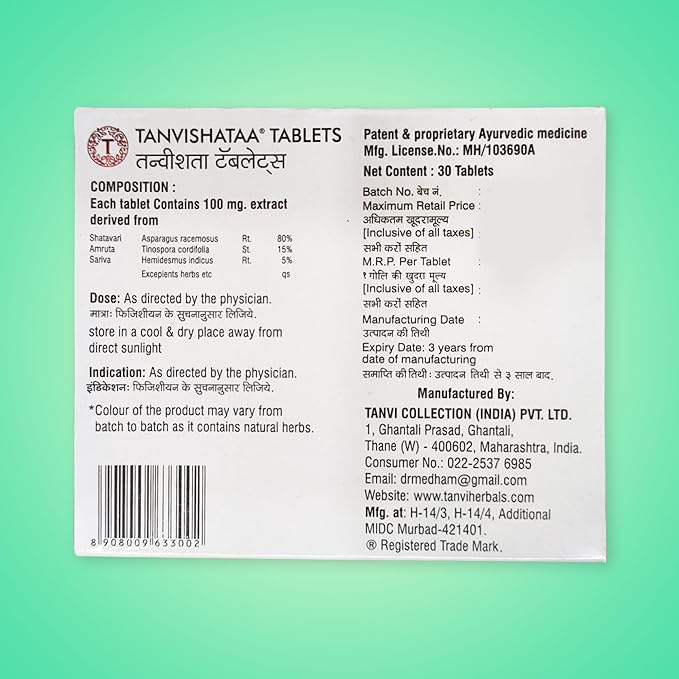
- This is a real, disclosed formulation — Shatavari 80%, Guduchi 15%, Anantmul 5% by weight of extract — not a hidden 'proprietary blend', and any supplement should always be taken as your physician advises.
Why does Tanvishataa combine three herbs instead of one?
"Why does Tanvishataa have three herbs, doctor — wouldn't Shatavari alone be enough?" I get some version of this question almost every week, usually from someone who has read about Shatavari online and wants to know why the tablet isn't just that.
The honest answer isn't marketing — it's classical Ayurvedic formulation logic. A single herb, however useful, tends to work on one or two aspects of the body's balance. Traditional Ayurvedic physicians rarely relied on one herb alone for a broad wellness goal; they combined herbs deliberately, each chosen for a specific role, so the formulation supported the person as a whole rather than one function in isolation.
What does Ayurveda actually mean by combining herbs?
Classical Ayurveda has a name for this: samyoga, the deliberate combination of substances so their qualities work together rather than in isolation. It is the same logic behind well-known classical formulations like Chyawanprash — a defined recipe of many ingredients, each with a traditional role, not a single herb simply scaled up.
What does Shatavari bring to the formulation?
Shatavari (Asparagus racemosus) is the lead herb in Tanvishataa, and for good reason. Classical texts describe it as a Rasayana — a category of herbs traditionally used to support the body's strength, resilience and balance over time, with a particular traditional association with women's energy and vitality across life stages.
What does Guduchi (Gulvel) bring to the formulation?
Guduchi (Tinospora cordifolia), also called Amruta in classical texts, is traditionally valued for two qualities that complement Shatavari: it is considered a Rasayana in its own right, traditionally used to support the body's natural defences, and it carries a deepana-pachana quality — traditionally believed to gently support digestive fire (agni), which Ayurveda treats as foundational to how well any herb or food is absorbed and used by the body.
What does Anantmul (Sariva) bring to the formulation?
Anantmul (Hemidesmus indicus), known classically as Sariva, is traditionally considered cooling in nature (sheeta virya). In classical Ayurveda it has long been associated with supporting skin wellness and a calm, balanced Pitta — rounding out a formulation that would otherwise lean heavily on Shatavari and Guduchi's warming, building qualities.
How are the three herbs actually combined? The Ghana Satva method
Combining herbs isn't just mixing three powders in a jar. Tanvishataa is prepared using the classical Ghana Satva method — each herb is processed into a concentrated extract (the herb's kashaya, or decoction, reduced down to a dense, potent form) before the three are combined in a fixed ratio and pressed into tablets.
This matters for consistency. A raw herb powder can vary from batch to batch depending on the plant, the season and the soil. A standardised concentrated extract, prepared the same way every time, is what allows every Tanvishataa tablet to carry the same composition as the one before it.
What is Tanvishataa's actual composition — and why this ratio?
Each Tanvishataa tablet contains 100mg of concentrated extract, made up of Shatavari root (80%), Guduchi/Amruta stem (15%) and Anantmul/Sariva root (5%), along with excipient herbs in small quantity (qs) to bind the tablet. This isn't a hidden 'proprietary blend' — it's the disclosed composition on the product label.
- Shatavari (80%) — the pradhan, or primary herb, carrying the formulation's main traditional role for women's everyday energy and balance.
- Guduchi/Amruta (15%) — the supporting Rasayana herb, traditionally chosen for immunity support and its gentle deepana-pachana (digestion-supporting) quality.
- Anantmul/Sariva (5%) — the cooling herb, traditionally included to balance the formulation's overall energetic quality and support skin wellness.
How is Tanvishataa traditionally taken?
As per the product label, the traditional usage is 2 tablets twice daily after meals with water for the first 3 months, moving to a maintenance dose of 1 tablet twice daily after that. This dosage guidance is on the pack itself — always follow the label, and check with your physician if you're unsure what's right for you.
Who should check with a doctor before starting?
Herbal doesn't mean suitable for everyone, in every situation. If you are pregnant, breastfeeding, managing a chronic condition, or taking regular medication, speak to a qualified doctor before starting Tanvishataa or any new herbal supplement — and never stop a prescribed medicine on your own to try a herbal alternative.
When should you see a doctor rather than rely on a supplement alone?
A wellness formulation like Tanvishataa is meant to support an already-healthy routine — it does not diagnose or treat illness. If you notice persistent symptoms, unexplained changes in weight or energy, or anything that concerns you and doesn't improve, that calls for a qualified doctor's assessment, not just a supplement.
References & further reading
- Sharangdhara Samhita — formulation (yoga) as the considered combination of dravyas, a foundational concept in classical Ayurvedic pharmacy (classical Ayurvedic text).
- Charaka Samhita — Shatavari described among the Rasayana herbs traditionally associated with women's strength and vitality (classical Ayurvedic text).
- Classical Ayurvedic texts describing Guduchi (Amruta) as a Rasayana herb with a traditional deepana-pachana (digestion-supporting) quality.
- Classical Ayurvedic texts describing Anantmul (Sariva) as sheeta virya (cooling in nature), traditionally associated with skin wellness and Pitta balance.
- These references describe traditional Ayurvedic concepts and formulation philosophy, and are not statements of medical fact about any specific product's clinical effect.
Ayurvedic wellness tips, guides and stories — in your language.
Buy NowFrequently asked questions
Why does Tanvishataa combine three herbs instead of just one?+
Classical Ayurvedic formulation (samyoga) traditionally combines herbs with complementary roles rather than relying on one herb for everything. Shatavari is the primary herb, with Guduchi and Anantmul traditionally included to round out the formulation.
What is Ghana Satva, and why does it matter for Tanvishataa?+
Ghana Satva is the classical method of reducing a herb's decoction into a concentrated, standardised extract. It's how Tanvishataa's three herbs are processed before being combined, which helps keep the composition consistent from tablet to tablet.
What is the exact composition of Tanvishataa?+
Each tablet contains 100mg of concentrated extract: Shatavari (80%), Guduchi/Amruta (15%) and Anantmul/Sariva (5%), plus excipient herbs in small quantity to bind the tablet — the full composition is disclosed on the product label.
Can I take Tanvishataa along with my prescribed medicines?+
Speak to your doctor before combining Tanvishataa with any prescribed medication, especially for chronic conditions. Never stop a prescribed medicine on your own to try a herbal supplement.
How should Tanvishataa be taken?+
As per the product label: 2 tablets twice daily after meals with water for the first 3 months, then 1 tablet twice daily as a maintenance dose. Always follow the label and consult your physician if you're unsure.
Dr Rucha Mehendale Pai
BAMS (Ayurvedacharya) · Nadi Parikshan Expert
Dr Rucha is an Ayurvedic physician with over a decade of clinical practice in women’s health, digestion and lifestyle wellness, and the formulator behind Tanvi Herbals’ Tanvishataa. She writes to bring authentic, everyday Ayurveda to families across India.