
Immunity
Guduchi (Giloy): Ayurveda’s Classic Immunity Herb, Explained

Key takeaways
- Guduchi — also called Giloy or Gulvel (Tinospora cordifolia) — is one of Ayurveda’s most respected Rasayana (rejuvenating) herbs.
- Classical texts group it among herbs that help balance all three doshas, which is why it is traditionally valued through every season.
- In Ayurveda, lasting immunity is less about a quick “boost” and more about steady agni (digestive fire) and clean, well-nourished tissues built over time.
- Guduchi is one of the three herbs in Tanvishataa — used as part of a daily routine, alongside a physician’s guidance when you are unwell.
What exactly is Giloy?
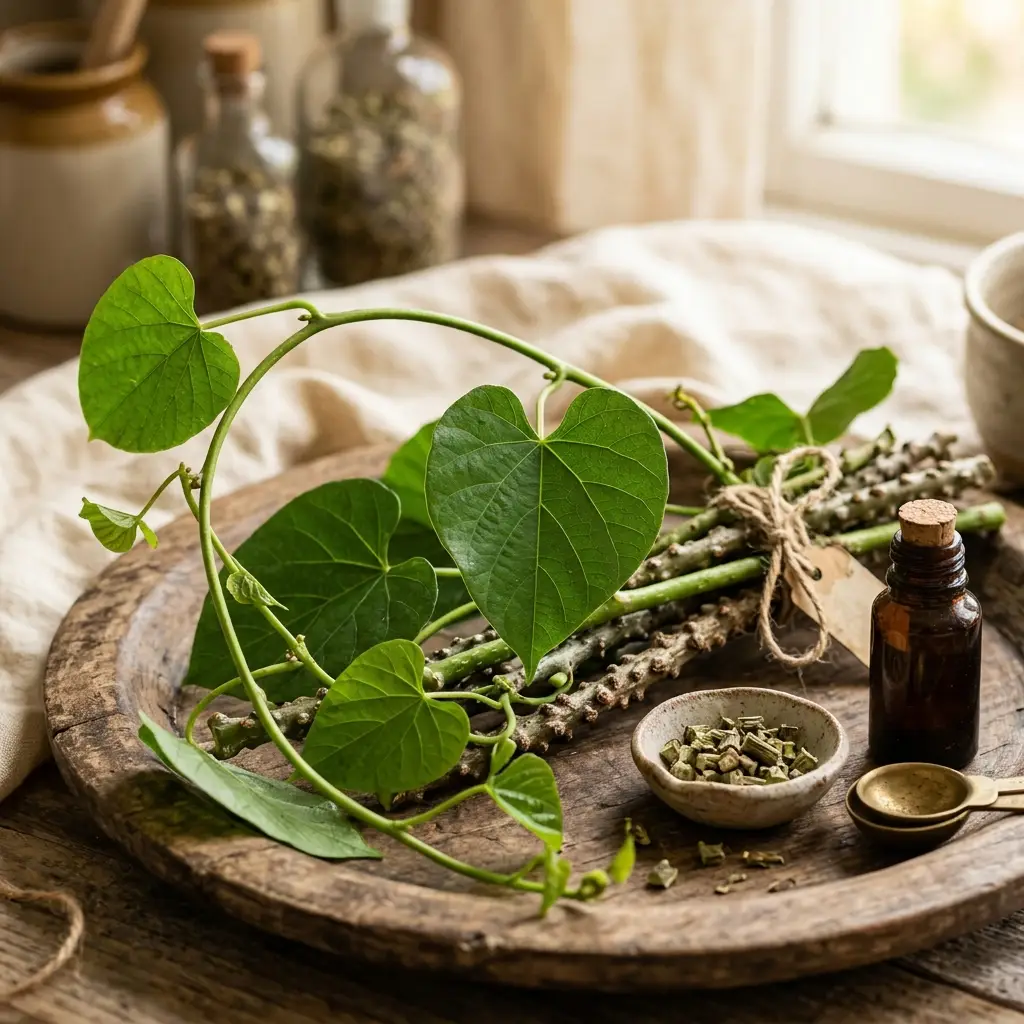
Giloy — known in Sanskrit as Guduchi and in Marathi as Gulvel — is a climbing shrub (Tinospora cordifolia) that grows wild across much of India, often winding up neem and mango trees. In Ayurveda it carries an evocative second name, Amruta, “the nectar of immortality”, a nod to how highly the classical physicians regarded it.
It is one of the three herbs at the heart of Tanvishataa, and arguably the one Indian families recognise most readily — many remember a grandmother boiling its stem during the monsoon.
What do the classical texts say about it?
Across Ayurveda’s foundational works, Guduchi is described as a Rasayana — a rejuvenating herb traditionally used to maintain strength, vitality and the body’s natural resilience over time. It is also classed as tridoshic, meaning it is considered gentle enough to help balance Vata, Pitta and Kapha rather than aggravating any one of them.
How does Guduchi support immunity, the Ayurvedic way?
In Ayurveda, immunity (often discussed as bala and ojas) is not a switch you flip; it is the slow result of good digestion and clean tissues. When agni — the digestive fire — works well, food becomes nourishment rather than ama (undigested residue), and the body stays resilient. Guduchi is traditionally used to support this whole picture rather than to “fight” any one germ.
It is traditionally seen as supporting agni
Classical texts describe Guduchi as deepana-pachana in quality — supportive of healthy digestion. Since Ayurveda roots immunity in digestion, this is central to why it is valued.
It is a season-change companion
Ritu sandhi — the junction between seasons — is when many people feel run down. Guduchi’s reputation as a tridoshic herb is exactly why it is traditionally turned to during the monsoon and at seasonal transitions.
- Traditionally classed as a Rasayana (rejuvenating) herb
- Considered tridoshic — gentle across Vata, Pitta and Kapha
- Valued for supporting agni, the seat of immunity in Ayurveda
- A long-standing monsoon and season-change companion
How is Guduchi used in a modern routine?
Traditionally Guduchi was taken as a decoction (kadha) or powder. Today, a concentrated extract is far more convenient. Tanvishataa brings Guduchi together with Shatavari and Anantmul using the classical “Ghana Satva” method, which concentrates the herbs into a small daily tablet — generally taken as two tablets twice a day after meals with water, or as advised by your physician.
Like all Rasayana herbs, it is meant to work gently and consistently over time as part of a healthy routine — not as an overnight remedy, and not as a replacement for medical care when you are genuinely unwell.
When should you see a doctor instead?
A herb that supports everyday wellness is not a substitute for medical attention. A high or persistent fever, breathlessness, a cough that lingers, or any infection that is worsening needs a qualified doctor, not a supplement. If you are pregnant, breastfeeding, managing a long-term condition or on regular medication, speak to your physician before adding any herb — and never stop prescribed treatment on your own.
References & further reading
- Charaka Samhita — Guduchi among the Rasayana dravyas (classical Ayurvedic text).
- Sushruta Samhita — Guduchi (Amruta) and its traditional qualities (classical Ayurvedic text).
- Ashtanga Hridaya by Vagbhata — Guduchi and seasonal balance, ritucharya (classical Ayurvedic text).
- These references describe traditional Ayurvedic concepts and are not statements of medical fact.
Ayurvedic wellness tips, guides and stories — in your language.
Buy NowFrequently asked questions
Is Giloy the same as Guduchi and Gulvel?+
Yes — they are three names for the same herb, Tinospora cordifolia. “Giloy” is the common Hindi name, “Guduchi” the Sanskrit name, and “Gulvel” the Marathi name.
Does Guduchi boost immunity instantly?+
No. In Ayurveda it is a Rasayana, traditionally used to support the body’s natural resilience gradually, as part of a routine. It is not an instant fix and not a treatment for any disease.
Can I take Guduchi every day?+
It is traditionally used as a daily Rasayana. In Tanvishataa it is generally taken as two tablets twice a day after meals, or as advised by your physician. Consult a doctor if you are pregnant, breastfeeding or on medication.
Is Guduchi only for the monsoon?+
No. It is valued year-round, but it is especially associated with the monsoon and the junctions between seasons (ritu sandhi), when many people feel more run down.
Does Tanvishataa treat infections or fever?+
No. Tanvishataa is a herbal wellness supplement traditionally used to support everyday immunity and digestion. Fever or infection should be assessed by a qualified doctor.
Dr Rucha Mehendale Pai
BAMS (Ayurvedacharya) · Nadi Parikshan Expert
Dr Rucha is an Ayurvedic physician with over a decade of clinical practice in women’s health, digestion and lifestyle wellness, and the formulator behind Tanvi Herbals’ Tanvishataa. She writes to bring authentic, everyday Ayurveda to families across India.